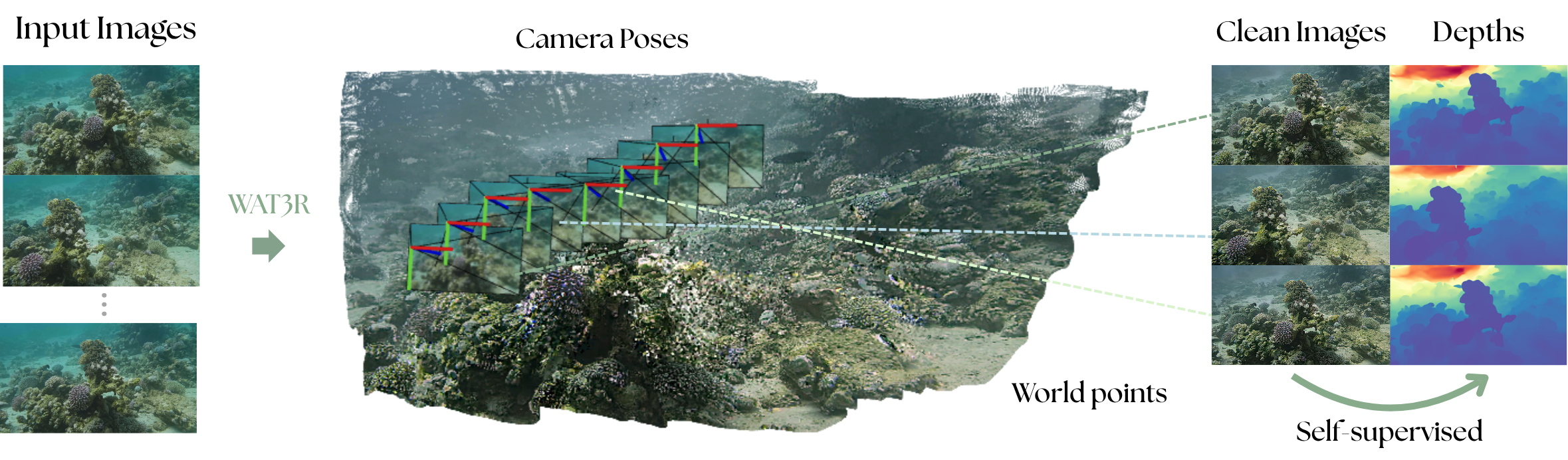
Reliable feedforward underwater 3D reconstruction remains challenging due to severe light attenuation and backscattering, which degrade visual quality and disrupt feature consistency across views, leading to inaccurate multi-view geometry. To address this issue, we propose WAT3R, a feed-forward framework for reconstructing 3D scenes directly from underwater images. By leveraging degradation adaptation as a geometry-constrained process, WAT3R integrates a lightweight neural adaptation module to flexibly account for these underwater imaging effects, thereby improving multi-view reconstruction quality. Implemented in a single forward pass, WAT3R directly and efficiently outputs pixel-aligned 3D point maps and camera poses from underwater videos, allowing a high-quality underwater 3D reconstruction. Experiments conducted on the FLSea, SQUID, and USOD10K datasets show that our method consistently outperforms state-of-the-art approaches on 3D reconstruction tasks, including multi-view/monocular depth estimation and camera pose estimation.
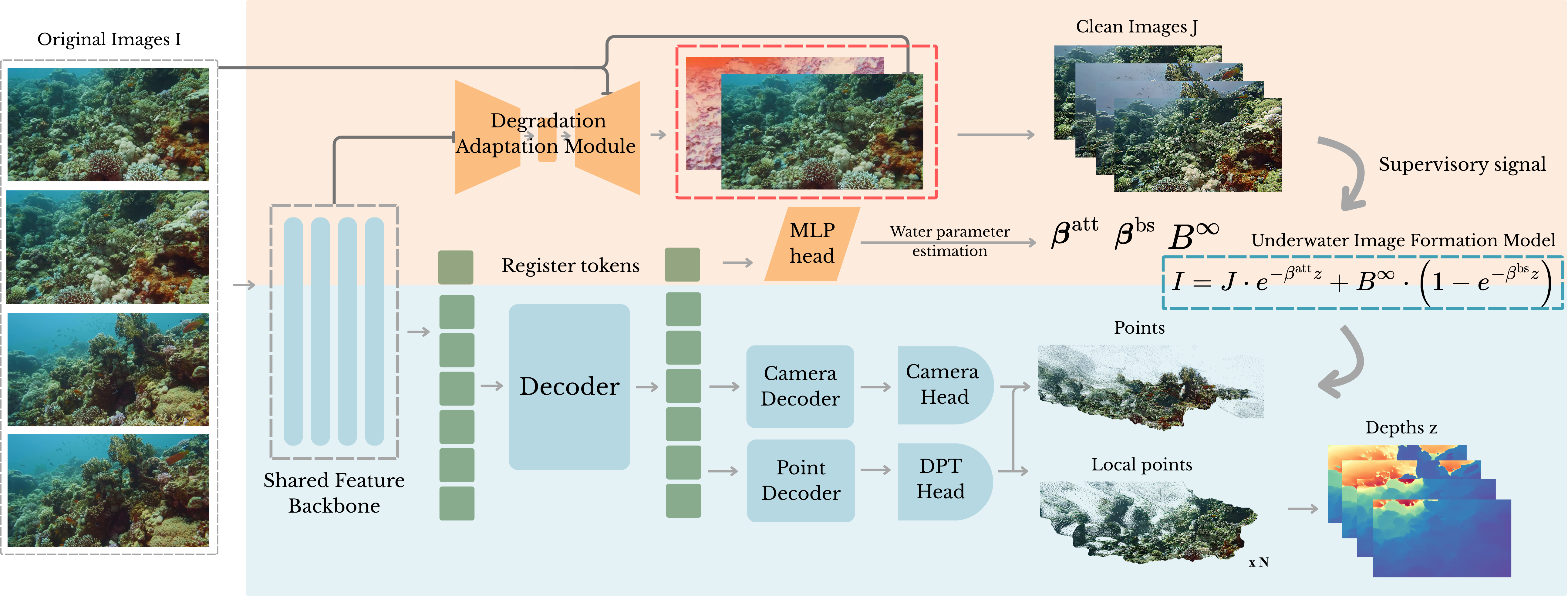
Overview of the WAT3R framework. Our method integrates a degradation adaptation module with a 3D reconstruction pipeline. By incorporating an underwater image formation model, WAT3R utilizes degradation-aware adaptation to implicitly refine depth estimation and 3D point cloud estimation from original images.
We show the 3D reconstruction results of WAT3R on underwater video sequences, outputting pixel-aligned 3D point maps and camera poses in a single forward pass.
Here we show the underwater image restoration results of WAT3R. Drag the slider to compare the original underwater frame (left) with the restored output (right).
@misc{xu2026wat3rfeedforwardunderwater3d,
      title={WAT3R: Feedforward Underwater 3D Reconstruction},
      author={Jiayi Xu and Jiahao Lu and Ziqiang Zheng and Yihao Tan and Yaolong Zhu and Yuan Liu and Sai-Kit Yeung},
      year={2026},
      eprint={2607.21023},
      archivePrefix={arXiv},
      primaryClass={cs.CV},
      url={https://arxiv.org/abs/2607.21023}}